How Do You Plan and Track Your AER Mandatory Closure Spend for 2027?
Search the AER mandatory closure spend and you will get the number within a sentence. The industry closure quota for 2027 is $750 million, your company gets a share of it proportional to your inactive liability on 17 September 2026, and the AER releases that share through OneStop in late September. That is correct, and it is the least useful part of the answer.
The number is not the problem. The year underneath it is. A quota arrives as one figure and then gets spent across a portfolio running from a few hundred sites to several thousand, where two wells carrying the same deemed liability can cost wildly different amounts to actually close. That planning happens now, in October to December, before the quota year starts. Here is how the quota is calculated, what counts, what changed for 2027, and what the people who actually run the closure program do with the number between the day it lands and the 31 March report.
At a Glance
- The 2027 industry closure quota is $750 million. Your licensee quota is your inactive liability divided by industry inactive liability, multiplied by that figure, assessed as of 17 September 2026
- That snapshot has passed, so the 2027 number is set. Reconcile it against your OneStop liability assessment report now, not in March
- Eligible closure work is broad: site assessments, Phase 1 and Phase 2 work, cut and cap, remediation, reclamation and lab analysis. Suspension, reactivation, work on producing sites, GST and overhead above 3% do not count
- Planning happens in October to December, and it is a per site exercise. Two sites with the same deemed liability rarely cost the same to close
- Everything goes into OneStop by 31 March, by category and infrastructure type. Miss the quota and the AER may require a security deposit for the difference, direct the timing of your closure work, or require additional reporting
What Is the AER Mandatory Closure Spend?
The AER mandatory closure spend is the minimum dollar amount a licensee must spend each year on abandonment, remediation and reclamation of inactive infrastructure. It has applied to every licensee with inactive inventory since January 2022 under Directive 088, and it is enforced through annual reporting in OneStop.
It exists because inactive liability was accumulating faster than anyone was retiring it. The AER sets one industry closure quota each year, weighing inactive liability, the previous year’s closure performance, commodity prices and service sector availability, then divides that total across licensees. Bulletin 2026-33, published 4 August 2026, set the 2027 industry number at $750 million. The trajectory is worth knowing: the industry requirement was $700 million for 2024, rose to $750 million for 2025, and has held at $750 million for 2026 and 2027. Three flat years in a row.
Three years of a flat industry quota does not mean three years of a flat quota for you. Your share moves with your inactive liability and with everyone else’s, and it is re-struck every year against a fresh snapshot. A flat industry number with your inactive inventory growing means your quota goes up.
How Is Your 2027 Closure Quota Calculated?
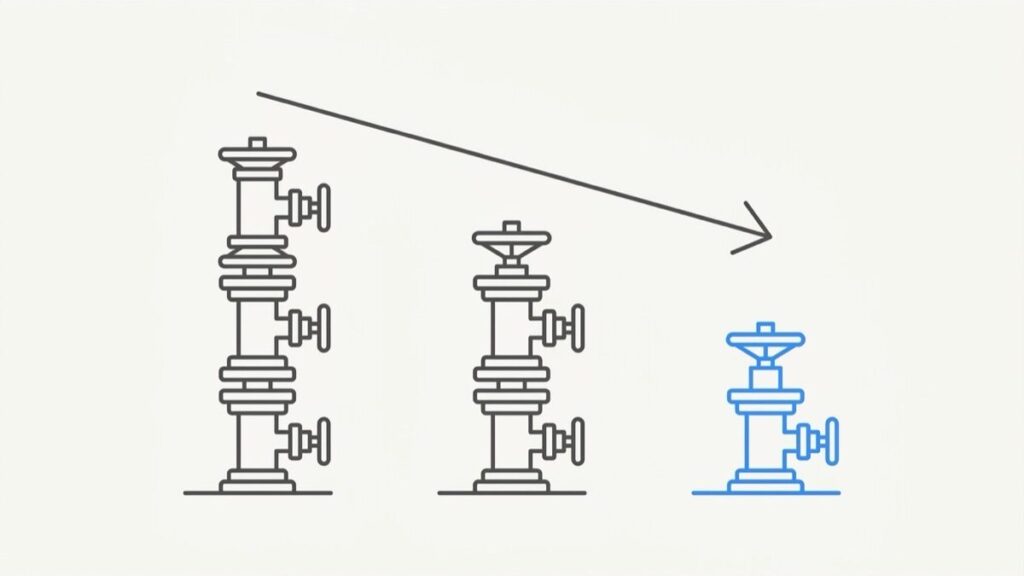
Your licensee quota is your proportionate share of the industry quota: your inactive estimated liability divided by the industry’s inactive estimated liability, multiplied by $750 million. The AER assessed inactive liability as of 17 September 2026 and releases each licensee’s 2027 quota through OneStop in late September.
The arithmetic is simple. If your inactive liability is one tenth of one per cent of the industry total on the snapshot date, your 2027 quota is one tenth of one per cent of $750 million, or $750,000. There is no official AER calculator: the Closure Quotas page gives the formula and OneStop gives the answer.
One thing changed underneath that formula and it is easy to miss if you last looked in 2025. Through 2022 to 2025 the AER used a two-rate approach that weighted a licensee’s financial health, assessed from Directive 067 submissions, so a financially distressed licensee could carry a lower spend rate. Bulletin 2025-27 discontinued that starting with the 2026 spend year. Every licensee now gets a straight proportionate share, distress or not. If your 2025 quota felt lighter than your inventory implied, that discount is gone.
The input deserves more attention than the formula. Inactive liability is estimated using Directive 011 regional values unless you have a site-specific assessment on file, and those deemed values are blunt: deemed liability is not what the work actually costs at your sites. So abandoning and reclaiming sites before a snapshot lowers the following year’s quota as well as your liability, and closure finished from here on shows up in the next snapshot, not the one just taken. If your own cost data says the deemed number is wrong, an AER liability tracker holding both numbers is what lets you show it.
What Counts as Closure Spend, and What Does Not?
Eligible closure spending is the reasonable cost actually incurred abandoning, remediating and reclaiming inactive and abandoned sites. Costs on a well shut in during the program year still count, provided the well is progressing to abandonment and reports no production once the year closes. The AER verifies licence status twice: when you submit, and again at the deadline.
The eligible list is broader than most operators expect: site assessments, Phase 1 and Phase 2 work, cut and cap, remediation, reclamation and lab analysis all count. Eligibility is rarely the hard part. Cost is. The same activity on two sites can differ by an order of magnitude depending on the province, whether the land is Crown, private or First Nation, whether there are historical spills on file, and how far the damage extends. That variance is what the quota gets split against.
The double status check is the trap that does catch people. Spending applies only if the licence carries a verified inactive status on submission day or on the deadline. Work on a site that comes back on production in between is work you paid for and cannot count.
The exclusions that bite: GST, overhead above 3% of eligible expenditures, suspension or reactivation, closure work on active sites with reported production, and invoices for work that has not happened yet. That 3% cap was written in plainly in the July 2026 edition of Manual 023, so a 2025 assumption about overhead is worth rechecking.
Two timing mechanics catch more people than the exclusion list. Access costs follow the work, so an ice road built in December to reach sites abandoned in January belongs to the year the abandonment completed, split across the sites it served. And where several submissions share the same year, category, type and licence, only the latest is assessed; if it is ruled ineligible, the earlier valid one is not reinstated.
The real exposure is not a rejected invoice. It is reaching year end having spent against sites where the status moved, or not knowing until the fourth quarter that the program will come up short.
How Do Operators Track Spend Against the Quota Through the Year?
The quota lands as one number in late September and has to become a closure budget per site before January. Most of that work happens between October and December, against the portfolio the operator plans to close the following fiscal year. The AER then wants the spend back per licence, by category and infrastructure type, by 31 March.
What actually happens between October and December
Across the closure programs Fieldshare works with, the pattern is consistent. The licensee takes its quota, sets an internal closure amount per well against the portfolio it intends to reclaim or close in the next fiscal year, and splits the budget across that program. A $400,000 quota might go out as an even split across the sites in the plan. The goal sitting under every one of those numbers is not a compliance goal: it is to close each site as quickly and as cheaply as possible, because that is what keeps the closure program affordable.
The portfolios this runs across are not small, ranging from a few hundred sites at a junior operator to several thousand at a large one. That is why “how much have we spent so far” is a genuinely hard question to answer in July.
Tracking splits two ways today. Some operators run it in Fieldshare. The rest accumulate vendor invoices through the year, pull them into a spreadsheet alongside whatever their well file tool holds, and track it there. That holds up until someone needs spend per licence, split by category and type, as of today rather than as of year end.
What the tracking has to produce
Every dollar has to be attributable three ways: to a licence, because that is the unit the AER assesses; to a category and type from the Manual 023 list, because OneStop will not take it otherwise; and to a calendar year, since partial reporting by stage is allowed but the milestone rules differ per activity.
Which makes closure spend a work plan problem rather than a bookkeeping one. Fieldshare’s ARO product is built for that shape: activity budgets per project tied to surface locations, projects linked to public assets so UWIs and licence numbers stay in sync, and activity tracked by year and by site. It tracks annual mandatory spend commitments against ARO reduction goals in one view, which is the view the March submission needs. Operators running that picture in asset retirement obligation software can also forecast the spend alongside production and budget instead of treating the quota as a separate exercise.
What the AER assesses | What a spreadsheet usually gives you | What the submission needs |
|---|---|---|
Spend per licence | A cost centre per project or area | Every dollar mapped to a UWI or licence number |
Spend by category and type | One “closure” column | Abandonment, ESA, remediation, reclamation, split by well, facility and pipeline |
Spend by calendar year | Whatever the invoice date says | The year the work completed, with partial stages reported deliberately |
Licence status at submission and deadline | Not tracked | Verified inactive on both dates, or the spend does not count |
Progress against the quota | A total at year end | A running year to date figure you can act on in July |
What Changed for 2026 and 2027?
Four mechanics move your number after it is issued: banked spend, a one year reallocation for larger dry gas licensees, quota adjustments on licence transfer, and exemptions for small dry gas producers. All four sit in Bulletin 2026-33 and Manual 023, and none of them appear in the definitions most search results give you.
Banked spend
Exceed your quota by at least 20% in 2025 or 2026, while compliant, and the excess is banked for a later year. Announced in Bulletin 2025-27 and extended through 2028. Two limits: spending submitted after the 31 March deadline cannot be banked, and if a submission is later removed and drops you under the 20% threshold, the banked amount goes with it.
Reallocation for larger dry gas licensees
New for 2027 and easy to miss. A Dry Gas licensee larger than Micro or Junior on 17 September 2026 can have any deficit from its 2026 quota assigned to its 2027 quota instead, if it is compliant and has overspent its 2023 to 2025 quotas by an average of 20% or more. The AER calls this an exceptional measure in response to continued low gas prices and says it will contact affected licensees by email. Eligibility turned on your peer group on the snapshot date, so if you expected to qualify and no email has arrived, confirm the classification with the AER before you plan around it.
Licence transfers
For transfer applications submitted on or after 1 January 2026, the spend is adjusted for both parties on approval, based on the inactive liability attached to the licences when the quota was set. Once a transfer completes the previous licensee can no longer submit spend against those licences, which makes timing a live question in any package deal.
Exemptions
Licensees in the Producer, Micro or Junior Dry Gas peer group, with low total estimated liability, compliant with Directive 067 and not in CCAA proceedings, are exempt for 2027. All four criteria were assessed on 17 September 2026. Exempted quotas are redistributed to everyone else, and exempt licensees cannot bank spend.
What Should You Set Up Before the 2027 Quota Year Starts?
The 2027 number is set: the AER took its snapshot on 17 September 2026. What is still open is how the quota gets spent, and whether proving that spend in March 2028 is an export or an investigation. Most of that is decided between now and January, while the 2026 year is still closing out.
Seven things to have in place:
- Reconcile the quota against your liability assessment report. It sits in OneStop under Reports, filtered to Liability Management Framework, and the August 2026 edition of Directive 011 states plainly that keeping it correct is the licensee’s responsibility. Anything that looks wrong goes to LiabilityManagement@aer.ca now, not in March.
- Close out 2026 before you plan 2027. The 2026 year ends on 31 December and its spend is due in OneStop by 31 March 2027. Beat the 2026 quota by 20% or more while compliant and the excess is banked toward 2027, but spend submitted after that deadline cannot be banked.
- Map spend to licences, not projects. A cost that cannot be traced to a UWI or licence number cannot be submitted.
- Adopt the Manual 023 categories at the point the invoice is entered. Recoding twelve months of spend in March is where eligibility gets lost.
- Track licence status alongside spend, so a site that reactivates mid year is flagged before you count the money.
- Budget per site, not per even split. Dividing the quota evenly is a fair opening position, not a plan. What a site costs is driven by the province, the land, the spill history and the extent of the damage, none of which divide evenly.
- Set a mid year checkpoint in July, with a year to date figure and a named owner for the gap. Keep the records five years.
A quota that is going to be a work plan rather than a year-end scramble has to sit with the rest of the oil and gas asset management picture: sites, budgets, field activity and invoices in one place, the same argument as the rest of your oil and gas data management software stack. A number you can only assemble once a year is a number you cannot manage.
Want the 2027 quota to be a work plan instead of a March reconstruction? See how FieldAssets ARO tracks mandatory spend against liability, or book a demo and bring the person who files your OneStop submission.
Frequently Asked Questions
No. The formula is your inactive estimated liability divided by the industry’s inactive estimated liability, multiplied by the industry closure quota, which is $750 million for 2027. Your assigned 2027 quota is in the OneStop licensee quota report, available from late September 2026, next to the liability assessment report it was calculated from.
Four documents. Bulletin 2026-33 sets the 2027 quota, snapshot date and exemptions. Directive 088 holds the requirements. Manual 023 holds the calculation, the eligible spending rules and the reporting categories in appendix 2 (use the July 2026 edition). Directive 011, in its August 2026 edition, explains the liability assessment report your quota is calculated from.
Directive 088 states the requirements, including meeting your quota and reporting all closure activity and spending in OneStop by 31 March. Manual 023 is the detail behind it: how the quota is calculated, what spending is eligible, how banked spend works, and the categories and types you report against.
The AER may require a security deposit for the difference, direct the timing and priority of your closure work, or require additional reporting. Licensees with an average quota of $200,000 or less over the preceding three years have compliance assessed on a rolling three-year basis rather than a single year, and those at $50,000 or less can pay a security deposit in lieu.