
Ontario Regulation 588/17: A Practical Asset Management Plan Guide for Canadian Municipalities
Ontario Regulation 588/17 is not paperwork. It is a funding permission slip. If your asset management plan is not current, compliant, and backed by real inventory data, your access to provincial and federal infrastructure dollars is at risk, your next AMP update will be a scramble, and your council will eventually notice that the roads are getting worse while the budget presentations say everything is fine.
This is the reality for most Ontario municipalities under 20,000 population. O. Reg. 588/17 has been in force since 2018, and the last of its rolling deadlines landed in July 2025, which means every requirement is now live and the small-to-mid-size municipalities are the ones under the most pressure. They have the same reporting obligations as Ottawa or Mississauga, but none of the internal engineering staff, none of the specialized software, and none of the finance team bandwidth to treat asset management as anything other than a year-end scramble.
This guide covers what the regulation actually requires, where most municipalities are falling short, and what a software-backed asset management plan looks like when it stops being a compliance exercise and starts driving real decisions. The framing is Ontario-specific, but the problem shows up in every Canadian province and most US states.
At a Glance
- O. Reg. 588/17 applies to every Ontario municipality with no exemptions, and its four staged milestones rolled out from 2019 through July 2025, all of which are now in force
- Missing a milestone does not trigger a fine, but it can block access to provincial and federal infrastructure funding such as the Ontario Community Infrastructure Fund and the Canada Community-Building Fund, and weaken defensible insurance and audit positions
- The final July 2025 milestone, now in force, is the hardest: proposed levels of service and a financial strategy that demand current, defensible data as their baseline
- Small municipalities under 20,000 population carry the same obligations as large cities but with a fraction of the staff and budget
- The same asset management pressures apply across Alberta, BC, and the US, just under different regulatory frameworks
What Does O. Reg. 588/17 Actually Require?
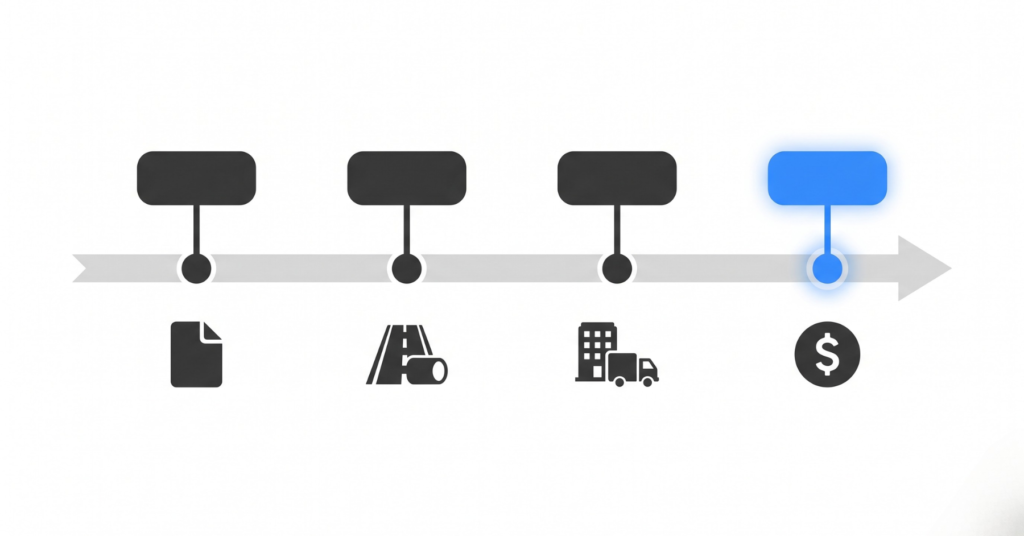
Ontario Regulation 588/17 requires every municipality in the province to publish a staged asset management plan covering inventory, condition, levels of service, and a long-term financial strategy, with no exemptions for population, geography, or budget size. The regulation was filed in late 2017, came into force January 1, 2018, and rolled out across four milestones that are now all in effect.
Reg. 588/17, officially titled “Asset Management Planning for Municipal Infrastructure,” applies to every single municipality in Ontario. The four milestones each build on the last.
Date | Milestone | Scope | Status |
|---|---|---|---|
July 1, 2019 | Strategic Asset Management Policy | Governance layer: who owns asset management decisions, council sign-off process, public engagement framework | Complete |
July 1, 2022 | AMP for core infrastructure at current LOS | Roads, bridges, culverts, water, wastewater, stormwater. Document what you own, condition, replacement cost, current service levels | Complete |
July 1, 2024 | AMP extended to all infrastructure at current LOS | Buildings, fleet, parks, recreational facilities, IT systems. Everything the municipality holds | Complete |
July 1, 2025 | Proposed LOS + financial strategy | Forward-looking service targets and a financial plan showing how the municipality will achieve them | In force |
The July 2025 milestone is the one that still trips up most small municipalities. The financial strategy requires current data to be defensible before you can project forward from it. If the inventory feeding your AMP has not been updated since the last filing, the projections are built on stale numbers, and with the deadline now passed there is no quiet runway left to fix it.
Missing a milestone does not trigger an automatic fine. It triggers something worse. Provincial and federal infrastructure funding applications reference the AMP. Insurance premium conversations reference the AMP. And auditors reference the AMP when they assess tangible capital asset valuations on your Financial Information Return.
What Three Asset Classes Does Every Municipality Have to Cover?
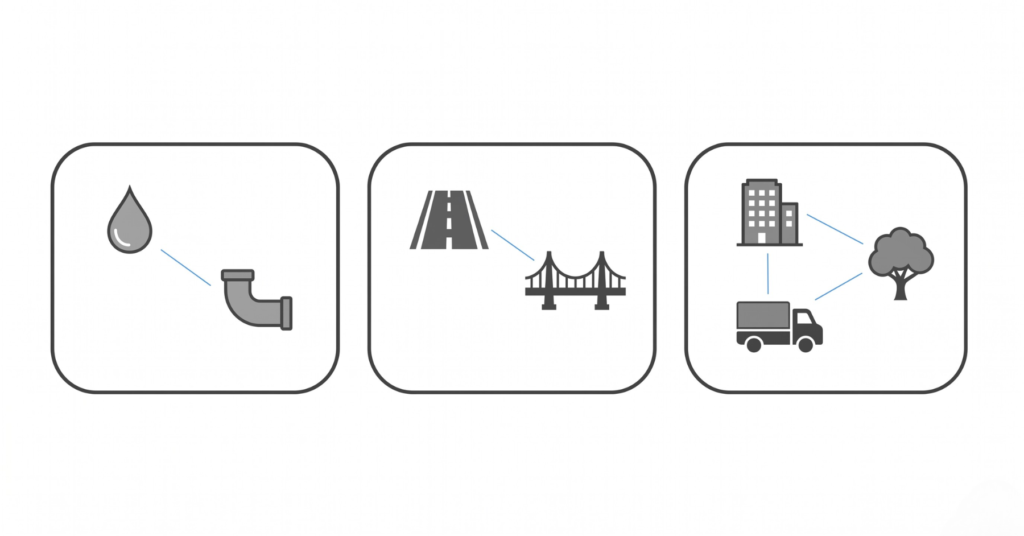
O. Reg. 588/17 splits municipal infrastructure into core and non-core, but the practical way to build the AMP is to think in three buckets: water infrastructure, transportation, and non-core assets. Each bucket has different lifecycle assumptions, different replacement cost curves, and different data update cadences.
Water Infrastructure
Water production, treatment, and distribution. Wastewater collection and treatment. Stormwater management. These assets have the longest lifecycles, the biggest replacement costs, and the most complex compliance overlap. Water systems also carry Ministry of the Environment, Conservation and Parks reporting obligations on top of O. Reg. 588/17. The same underlying data feeds both.
Transportation
Roads, bridges, and culverts. These are the assets the public notices first when they fail, which means council and community pressure are directly tied to condition data accuracy. Bridges and culverts are particularly tricky because Ontario Structure Inspection Manual (OSIM) reporting runs on a separate cycle, and the two data sources have to reconcile inside the AMP.
Non-Core Assets
Buildings, fleet, parks, IT systems, recreational facilities. The regulation pulled these in for the July 1, 2024 deadline, but the inventory for non-core assets is almost always worse than the inventory for core. Nobody was tracking fleet lifecycle with the same rigour they tracked water main replacement. The gap shows up in the AMP.
The municipalities with the cleanest AMPs are the ones that accept the three buckets are operationally distinct and track them with workflows that match. A single inventory system that pretends they are all the same collapses fast.
What Are Levels of Service and Why Do Most Municipalities Get Them Wrong?
Levels of service is the section of O. Reg. 588/17 that most small municipalities get wrong because the regulation asks for two things that look similar but are not: community levels of service (qualitative, resident-facing) and technical levels of service (quantitative, data-driven). The mistake is treating them as the same exercise.
Community vs Technical Levels of Service
Aspect | Community LOS | Technical LOS |
|---|---|---|
What it measures | Qualitative outcomes residents experience | Quantitative metrics that prove the outcomes |
Example (roads) | “Safe, reliable roads available throughout the municipality” | Average pavement condition index score |
Example (water) | “Reliable, clean, safe drinking water at all times” | Water main breaks per 100 km per year |
Who approves it | Council (regulation requires explicit approval) | Engineering/public works staff |
Risk if disconnected | AMP reads as compliant on surface scan but collapses under grant reviewer scrutiny | No data trail to defend the community-level claim |
The common mistake is copying community-level statements verbatim from Ontario.ca templates without connecting them to real technical data. You cannot say “reliable, clean drinking water” in your community LOS if you do not have the water main break data to prove it.
Why the July 2025 Baseline Is a Trap
The proposed levels of service set for the July 2025 milestone are forward projections. Whatever technical metric you reported becomes the baseline you are measured against for the next three, five, ten years. A baseline built from incomplete data is a trap, and now that the milestone has passed it is already sprung. The municipality committed to a target it cannot defend, the next AMP cycle will show the gap, and suddenly council is asking why service is declining when the real answer is that the original baseline was fiction.
How Do Infrastructure Grants and the FIR Tie Into Your AMP?
Provincial and federal infrastructure funding, from the Ontario Community Infrastructure Fund to the Canada Community-Building Fund, expects an approved, current asset management plan, which makes the AMP a gatekeeper document for the dollars that keep municipal infrastructure solvent. The Financial Information Return is the other piece, and the two filings should describe the same underlying reality but almost never do.
The Funding That Hinges on Your AMP
The Investing in Canada Infrastructure Program channelled billions into Ontario municipal projects between 2018 and its final intake in 2023, and an approved AMP was a baseline expectation for most streams. That gatekeeping did not disappear when ICIP closed to new nominations; it moved to the programs still funding municipalities today. The formula-based Ontario Community Infrastructure Fund delivers hundreds of millions a year to small, rural, and northern communities, and the Canada Community-Building Fund ties its Ontario allocations to asset management progress. The Federation of Canadian Municipalities runs a complementary Municipal Asset Management Program that provides grants specifically to help smaller municipalities build asset management capacity, and FCM’s MAMP readiness assessments are a useful diagnostic for where a municipality sits on the maturity curve.
Why Your AMP and FIR Rarely Match
The Financial Information Return captures tangible capital asset data annually for the Ministry of Municipal Affairs and Housing. In theory, the asset inventory in your AMP and the TCA schedule in your FIR should describe the same physical assets. In practice, they almost never do. Book value on the FIR uses historical acquisition cost and accounting depreciation. Replacement cost in the AMP uses today’s estimated cost to rebuild from scratch. Two different numbers, two different purposes, same physical asset.
The Municipal Finance Officers’ Association of Ontario has flagged this gap for years. Their guidance consistently points back to one thing: the underlying asset inventory has to be a single source of truth feeding both documents. When your AMP inventory and your FIR inventory are the same list, the reconciliation conversation disappears. When they are not, every audit cycle becomes a forensic exercise. Integrated reports across work orders, assets, and financials turn that reconciliation from a production job into a query.
What Mistakes Do Small Ontario Municipalities Keep Making?
Five patterns show up repeatedly in small-municipality AMPs, and each one makes the next compliance cycle harder. They compound. A municipality making two or three of these mistakes simultaneously is building an AMP that its own staff do not believe and its own council has never truly owned.
1. Treating the AMP as a Paperwork Exercise
A consultant produces the document, it gets filed with MMAH, council rubber-stamps it, and nothing about day-to-day operations changes. The AMP exists as a PDF on the municipal website. The public works director never opens it again until the next update cycle.
2. Using FIR Book Value as a Proxy for Replacement Cost
Book value is what you paid minus accumulated depreciation. Replacement cost is what it would cost to rebuild at today’s prices, in today’s regulatory environment. For a water treatment plant built in 1985, those numbers are an order of magnitude apart. An AMP built on book value will systematically underestimate the funding required to maintain service levels.
3. Not Updating Inventory Between Filings
Field crews do maintenance. New assets get commissioned. Old assets get decommissioned. None of it flows back into the central asset list. Three years later, the next update starts from stale data, and the work to reconcile reality with the record eats the entire cycle. Good project and asset tracking prevents the drift.
4. Undercovering Non-Core Assets
The July 1, 2024 deadline expanded scope to buildings, fleet, parks, and IT. Most small municipalities are still tracking these in departmental spreadsheets maintained by whoever inherited them. Bringing non-core into the AMP without first getting those spreadsheets under control produces an AMP that the municipality itself does not believe.
5. No Council Engagement on Levels of Service
The regulation explicitly requires council approval of LOS targets. When the AMP is produced by a consultant and signed off without a real council conversation about what the community expects, the municipality ends up committed to service targets the council never owned. The next budget request tied to those targets gets second-guessed.
What Does a Software-Backed Asset Management Plan Look Like?
The municipalities with the cleanest AMPs are not the ones with the biggest consulting budgets. They are the ones whose asset data lives in a system that field crews, finance, and council can all see in real time, so the AMP is a living document rather than a year-end production job. Choosing that system is its own decision, and our guide to municipal asset management software for small cities covers it in depth. Here is what that looks like across four capabilities.
Inventory That Updates from the Field
When a crew replaces a section of water main, the replacement record enters the system on the tablet at the job site. The age, material, and replacement date update in the central inventory. The next AMP cycle does not require a data cleanup project because the data never got stale.
Levels of Service Tied to Real Metrics
Technical LOS data is pulled directly from the same records where work orders, inspections, and service interruptions are logged. When a council member asks how many water main breaks happened last year, the answer is a filter on a screen, not a week of someone’s time assembling a report.
Financial Strategy Connected to Actual Inventory
Replacement cost estimates update as unit costs change. Lifecycle funding requirements roll up from individual asset records into the 10-year capital plan. When the CAO asks what the funding gap looks like if capital contributions drop 5 per cent, the answer comes from the same system that runs the inventory. Budget tracking and AMP data live in the same place.
Council Sees What the Field Sees
A monthly dashboard showing condition by asset class, capital spend to date, service level performance against target, and upcoming replacement priorities. The AMP stops being a compliance artifact and starts being the operational decision-making document it was supposed to be.
At scale, the payoff is real. The City of Medicine Hat is an Alberta municipality, not an Ontario one, but the operational pattern translates: one coordinator manages roughly 2,750 active sites because the data centralization makes that workload possible. A small Ontario municipality dealing with a few hundred core assets plus non-core inventory is working at a tenth of Medicine Hat’s scale, which makes the same approach more achievable, not less.

How Does the Same Problem Show Up in Alberta, BC, and the US?
Ontario has the strictest version of a problem every Canadian and US municipality is already dealing with. The deadlines are the loudest and the compliance framing is the cleanest, but the same pressure is on Calgary and Kelowna and Spokane just as much as Mississauga. The rules look different on paper. The job on the ground is the same.
Alberta
There is no provincial equivalent to O. Reg. 588/17. Alberta municipalities run under the Municipal Government Act, which touches asset management through capital planning rather than a publication mandate. But the Local Government Fiscal Framework, Alberta’s provincial infrastructure funding program that took over from the Municipal Sustainability Initiative in 2024, has asset management expectations built directly into its reporting conditions. Add the Public Sector Accounting Board’s Section 3150, which requires every Canadian municipality to report tangible capital assets on annual financial statements, and Alberta ends up managing the same asset data Ontario does. Just without a regulation naming the job.
British Columbia
BC runs on a framework, not a regulation. Asset Management BC, a program hosted by the Union of BC Municipalities, publishes the Asset Management for Sustainable Service Delivery framework. The lever is federal. The Canada Community-Building Fund, the federal transfer that replaced the Gas Tax Fund, ties BC municipal access to asset management progress reporting. No regulation. No hard deadlines. The data requirements still look almost exactly like what Ontario has to produce under O. Reg. 588/17.
United States
US municipalities are not under a federal asset management regulation, but two forces point in the same direction. GASB Statement 34 requires state and local governments to report infrastructure as capital assets, meaning condition and depreciation data has to live somewhere. FHWA requires state DOTs to keep Transportation Asset Management Plans current, a requirement established by MAP-21 and continued under the 2021 Infrastructure Investment and Jobs Act. EPA and FEMA programs carry similar conditions for water, wastewater, and resilience work.
Jurisdiction | Regulatory Driver | AMP Requirement | Financial Reporting Link | Funding Lever |
|---|---|---|---|---|
Ontario | O. Reg. 588/17 | Mandatory AMP with staged milestones finalized July 2025 | FIR to Ministry of Municipal Affairs and Housing | OCIF and CCBF funding tied to current AMP |
Alberta | Municipal Government Act + LGFF reporting | No formal AMP mandate, but LGFF reporting conditions require equivalent data | PSAB Section 3150 TCA reporting | Local Government Fiscal Framework conditions |
British Columbia | Asset Management BC framework (voluntary) | No mandate, but CCBF federal transfer ties funding to AM progress reporting | PSAB Section 3150 TCA reporting | Canada Community-Building Fund reporting |
United States | GASB 34 + FHWA TAMP rule | No federal AMP mandate; state DOTs required for transportation | GASB 34 infrastructure capital asset reporting | Federal transportation, EPA, and FEMA funding conditions |
Across all four jurisdictions, the municipality has to know what it owns, what shape those assets are in, what they would cost to replace, and how the work gets paid for. The software that answers those questions does not care which regulation you are compliant with. It cares whether the data is real.
Why Is Deferred Maintenance the Real Threat Behind Every AMP Update?
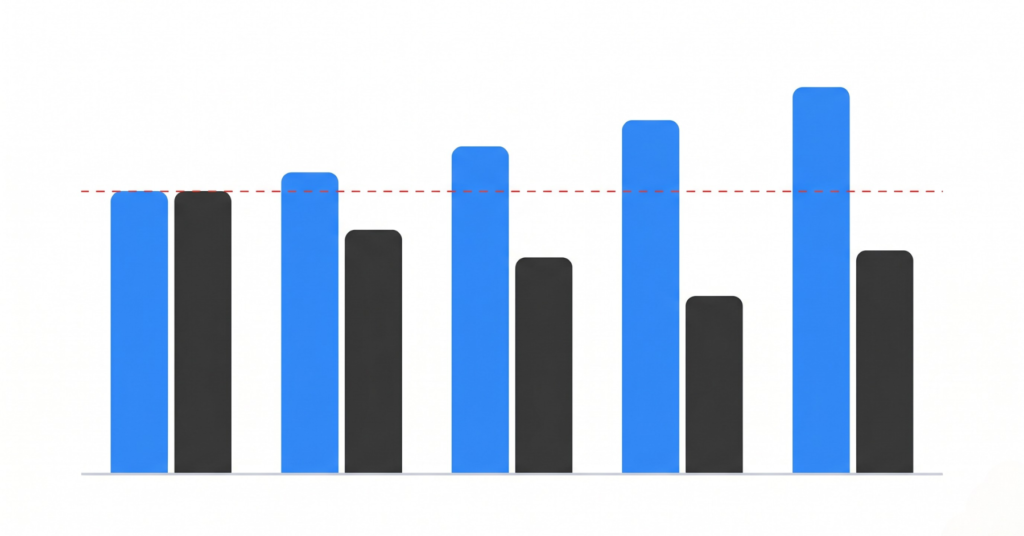
The Canadian Infrastructure Report Card has tracked municipal infrastructure condition nationally, and the findings are stark: roughly one-third of Canada’s municipal infrastructure is rated fair, poor, or very poor, and the reinvestment rate is not keeping pace with deterioration. Deferred maintenance does not stay static. It compounds.
A road that needs rehabilitation today costs a fraction of what full reconstruction costs in five years. A water main that could have been relined at moderate cost becomes a full replacement after the first major break. The infrastructure dollar deferred is rarely the infrastructure dollar saved. It is a dollar postponed into a larger future dollar, and eventually into an emergency replacement dollar.
For small municipalities under 20,000 population, the quiet compounding of deferred maintenance is the existential pressure sitting behind every AMP update. The regulation is not the threat. The regulation is an early warning system that forces municipalities to look at the gap before it becomes a crisis. The municipalities that take it seriously are using the AMP process to build the funding case for catching up. The ones that do not are hoping the next audit cycle pushes the conversation to someone else’s term.
Ready to build an asset management plan that drives decisions instead of sitting on a shelf? Book a Fieldshare demo and we will walk your public works and finance teams through how municipal asset management software keeps your inventory, levels of service, and financial strategy running off a single source of truth. The regulation is the same problem everywhere. Fieldshare is built for the problem.
Frequently Asked Questions
Ontario Regulation 588/17 is a provincial regulation that requires every municipality in Ontario to develop and publish a detailed asset management plan. Filed in 2017 and in force since January 1, 2018, it rolls out in four staged milestones covering strategic policy, core infrastructure inventory, all infrastructure inventory, and a forward-looking financial strategy. There are no exemptions for population or budget size.
Missing a milestone does not trigger an automatic fine. The consequences are functional: provincial and federal infrastructure funding programs such as the Ontario Community Infrastructure Fund and the Canada Community-Building Fund expect a current AMP, insurance premium conversations reference the AMP, and auditors use the AMP when assessing tangible capital asset valuations on the Financial Information Return. A municipality without a current AMP is effectively locked out of major funding streams.
The regulation requires two types of levels of service. Community levels of service are qualitative, resident-facing statements like “safe, reliable roads.” Technical levels of service are quantitative metrics like pavement condition index or water main breaks per 100 km that prove whether the community-level claims are true. Both must be documented in the AMP, and the July 2025 milestone, now in force, set the requirement for proposed future targets.
Yes. The regulation applies to every municipality in Ontario regardless of population, geography, or budget. Small municipalities under 20,000 population carry the same reporting obligations as Ottawa or Mississauga, which is why they are under the most pressure. The FCM Municipal Asset Management Program provides grants specifically to help smaller municipalities build the capacity to meet these requirements.
Alberta has no provincial equivalent to O. Reg. 588/17, but the Local Government Fiscal Framework has asset management expectations built into its reporting conditions, and PSAB Section 3150 requires tangible capital asset reporting. BC runs on a voluntary framework through Asset Management BC, but the Canada Community-Building Fund ties federal transfer access to asset management progress reporting. The data requirements across both provinces look almost identical to what Ontario mandates.
Purpose-built municipal asset management software keeps inventory, condition data, levels of service metrics, and financial projections in a single system that field crews, finance, and council can all access. Inventory updates happen in real time from the field, LOS metrics pull from the same work order records, and the financial strategy connects to actual replacement cost data. The AMP becomes a living document rather than a year-end scramble.