Why AI Won’t Fix Your Field Data Problems (And What Will)
Every conference in Calgary has an AI panel now. Every vendor pitch includes a slide about machine learning. Every industry magazine runs a feature on how artificial intelligence is about to transform oil and gas operations.
The pitch sounds good. The numbers do not back it up.
A 2024 study by the RAND Corporation found that more than 80% of AI projects fail, roughly twice the failure rate of non-AI IT projects. In oil and gas specifically, DNV’s 2024 Energy Industry Insights report found that only 3% of companies report advanced or highly integrated AI use in daily operations. Not 30%. Not 15%. Three percent.
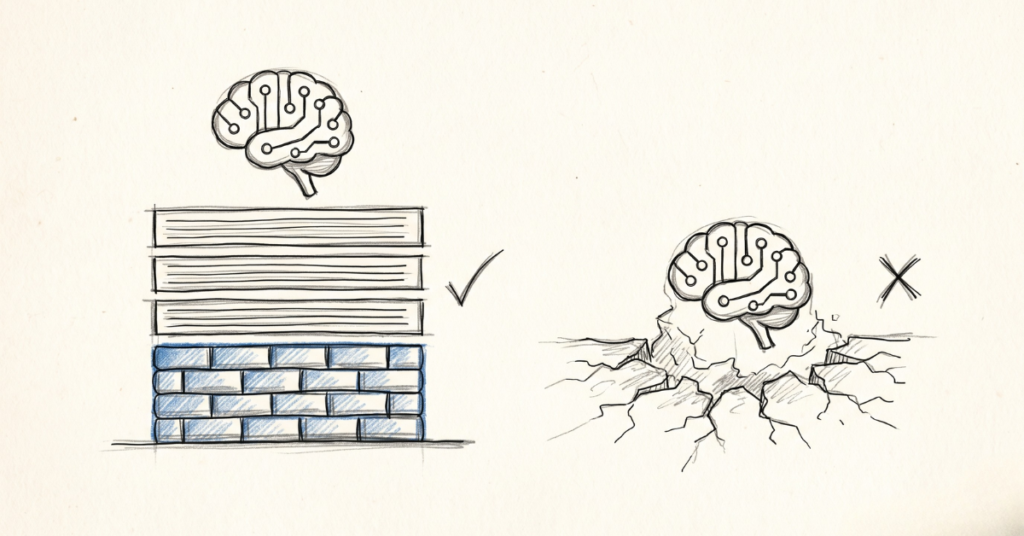
Understanding why AI fails in oil and gas matters more than understanding what AI can do. Because the failure almost never comes from the technology. It comes from the data and the workflows feeding it.
What Is the AI Track Record in Oil and Gas Really?
The gap between the conference keynote and the field office is enormous, and the data confirms it. DNV’s survey found that 47% of oil and gas companies are still in the planning or piloting stage for AI. Most of those pilots never scale beyond the sandbox environment where they were first demonstrated.
Deloitte’s research identifies why. Their analysis of digital transformation in upstream oil and gas identifies three sequential prerequisites: integrate diverse data sources, analyze and visualize, then augment with AI. The firms jumping straight to step three are the ones stuck in “pilot purgatory,” where the AI demo works in a controlled environment but collapses the moment it touches real operational data.
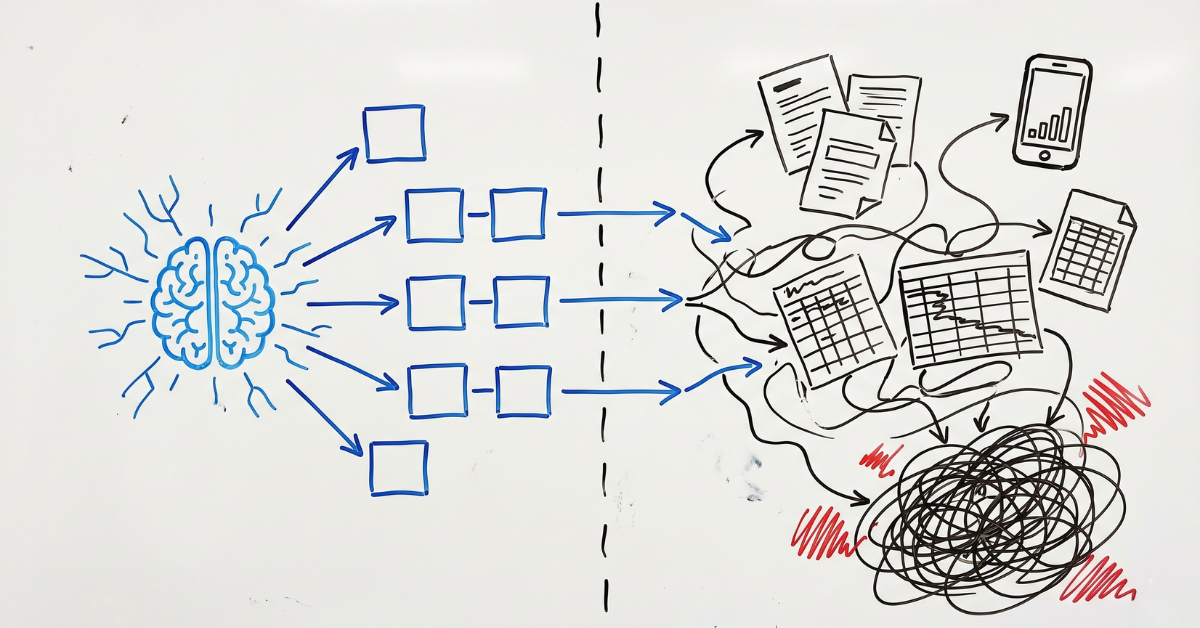
The cost of failure is not trivial. Industry analyses consistently show that infrastructure upgrades to support AI cost three to five times more than the initial software investment. Annual maintenance runs 15 to 20% of the original implementation cost. The result is predictable: operators spend months on a pilot, the pilot shows promise in a sandbox, the rollout hits real field data, and the project stalls. Not because the AI algorithm was wrong. Because the data it needed was scattered across 14 spreadsheets, three email threads, and a paper form in somebody’s truck.
Why Is 80% of an AI Project Just Data Cleaning?
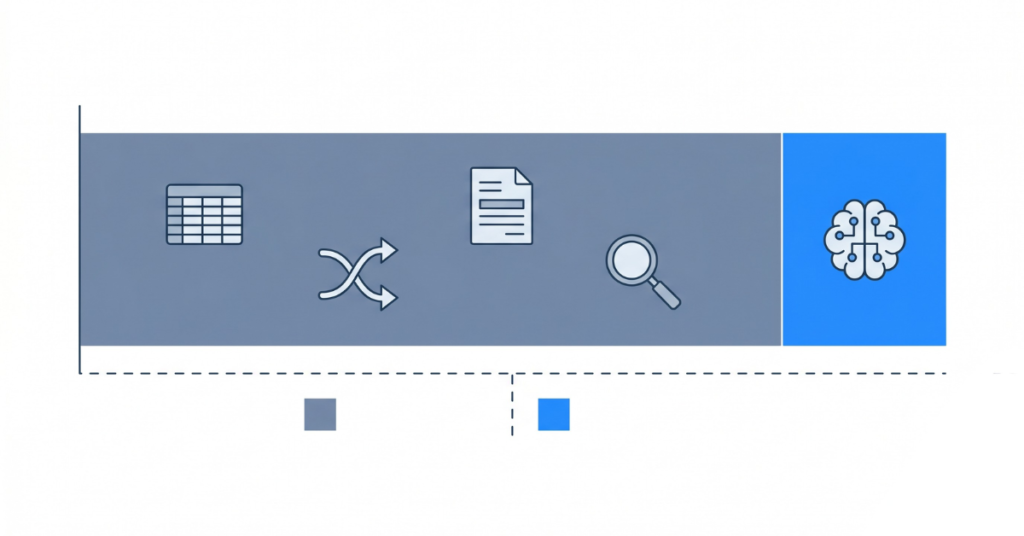
Andrew Ng, the Stanford professor who co-founded Google Brain and runs DeepLearning.AI, has been making this point for years: the data preparation work is not a preliminary step before the real AI work begins. It is the real work. As he told MIT Sloan: “If 80 percent of our work is data preparation, then ensuring data quality is the important work of a machine learning team.”
RAND’s researchers heard the same from practitioners. One data scientist they interviewed put it bluntly: “80 percent of AI is the dirty work of data engineering. You need good people doing the dirty work, otherwise their mistakes poison the algorithms.”
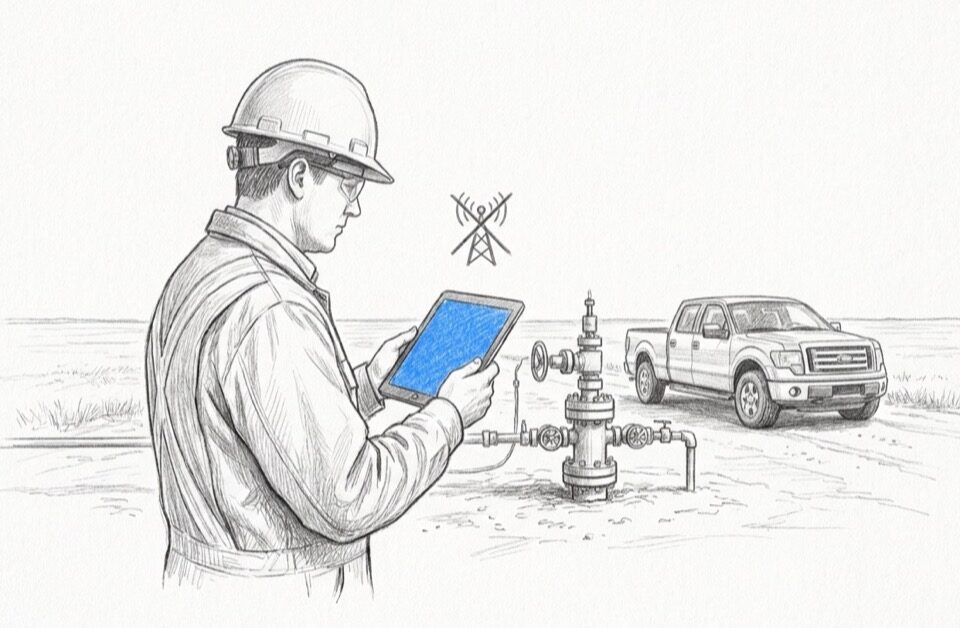
In oil and gas, that 80% is not an abstraction. It is a field tech writing readings on a paper ticket at a wellhead with no cell service. It is an environmental consultant emailing a CSV in a format nobody else uses. It is three project managers maintaining three separate budget spreadsheets for the same client. It is a production accountant spending a full day reconciling Petrinex volumes against internal tracking because the numbers never match on the first pass.
The Society of Petroleum Engineers has documented the scope of the problem. Their assessment is sobering: the industry “does not lack standards; in fact, it probably has too many of them, which leads to the real problem that most operators, service companies, and tech companies just don’t implement the data standards that apply.” Over 300 oilfield service firms operate with hundreds of proprietary tools and formats. AI trained on that inconsistency learns the inconsistency.
Matt Russell, a technology consulting manager at Ernst & Young, put the scaling problem clearly: “Scaling AI is not like cloud computing, where you can solve issues by adding more power. If you want a more robust or insightful AI, you need more robust, insightful information feeding it, and that increases operational complexity as well.”
You cannot add your way out of a data quality problem. You have to fix the data first.
Where Does AI Actually Deliver Value in Oil and Gas?
AI is not useless in oil and gas. It is useless when applied broadly to broken workflows. The distinction is between targeted automation with clean input data and general-purpose AI applied to an entire operation where the data chain is held together with email threads and good intentions. Understanding this distinction matters before diagnosing what is broken.
|
Factor |
AI That Works (Targeted, Clean Data) |
AI That Fails (General, Broken Data) |
|---|---|---|
|
Input data |
Structured, standardized, reported through systems like Petrinex |
Scattered across spreadsheets, emails, paper forms, and personal devices |
|
Scope |
Narrow, well-defined task (one variable, one output) |
Broad operational coverage across multiple workflows |
|
Data pipeline |
Clean and continuous, sensor-fed or system-generated |
Manual entry, re-entry, and transcription at every step |
|
Example applications |
Decline curve analysis, predictive maintenance, seismic interpretation |
Field data consolidation, contractor report merging, regulatory assembly |
|
Track record |
30%+ accuracy improvement (decline curves), 25% productive well life gains (Devon Energy) |
80% failure rate (RAND Corporation, 2024) |
|
What AI does |
Processes clean data at scale and speed |
Processes errors at scale and speed |
|
What fixes it |
Nothing needed; the foundation already works |
Fixing the data pipeline before deploying AI |
Decline curve analysis is the clearest success example. Machine learning models can forecast production decline for hundreds of wells in minutes, and published research in the Journal of Petroleum Technology shows they achieve over 30% higher accuracy than traditional Arps-based methods. That works because the input data (production volumes) is already structured, standardized, and reported through systems like Petrinex. The AI is not fighting the data. It is processing clean data at scale.
Predictive maintenance follows the same pattern. When sensor data from a pump jack or compressor feeds directly into a monitoring system in real time, AI can detect anomalies before equipment failure. Devon Energy reported a 25% improvement in productive well life from exactly this kind of application. It works because the data pipeline is clean and continuous.
Seismic interpretation has been using deep learning for years, turning weeks of manual interpretation into hours of automated analysis. Same pattern: the input is structured, standardized, and well-defined. The second column of the table above is where the 80% failure rate lives.
What Are the Four Workflow Bottlenecks AI Cannot Fix?
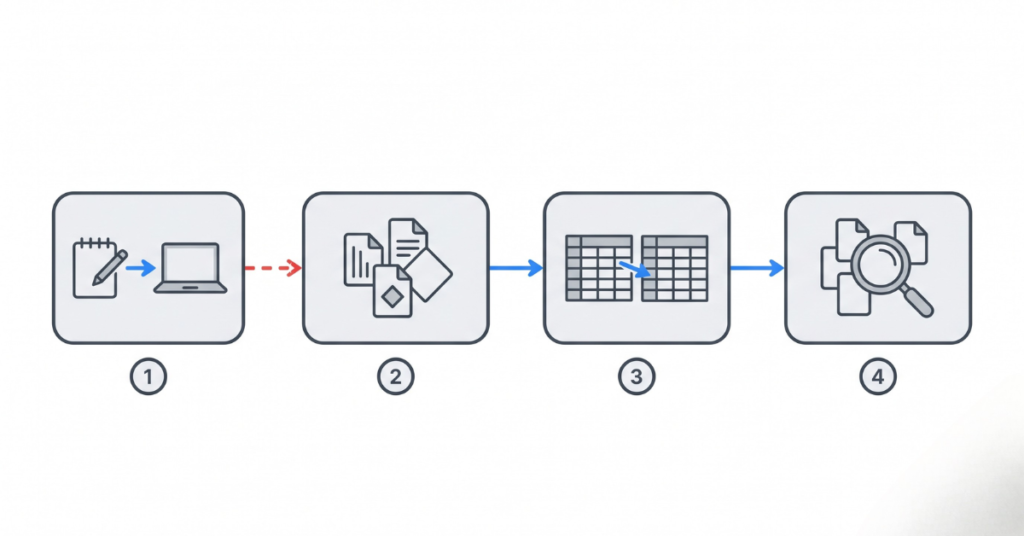
The places where oil and gas field data breaks down are specific and structural. They are process problems, not technology problems, and no amount of machine learning resolves them. These four bottlenecks explain why AI fails in oil and gas more clearly than any vendor white paper.
The Field-to-Office Handoff
Inspectors and field crews record data at well sites, pipeline rights-of-way, and remote facilities. Many of those locations have no cell service, no Wi-Fi, nothing. Data starts on paper or a personal device and gets re-entered into office systems hours or days later. Each re-entry is a manual transcription, and each transcription carries error risk. Offline data collection that syncs when connectivity returns eliminates this step entirely, but AI applied on top of the existing chain does not. It just processes the errors faster.
Contractor Format Inconsistency
A mid-size operator might work with ten to twenty different environmental consultants, each submitting data in whatever format they prefer. One sends a spreadsheet. Another sends a PDF. A third emails a summary. None of it matches. Fieldshare’s own client experience bears this out: before the City of Medicine Hat centralized data collection, one coordinator was consolidating reports from 15 to 20 different consultants across roughly 2,750 active sites. The format mismatch alone consumed more time than actual project management.
Parallel Spreadsheet Tracking
When every project manager maintains their own workbook for budgets, tickets, invoicing, and progress, nothing reconciles. The data exists, but it lives in personal files that no one else can access, audit, or trust. Companies that addressed this by centralizing project tracking into a shared system (not by adding AI on top of the spreadsheets) saw direct, measurable results: faster invoicing, fewer budget overruns, and the ability for anyone on the team to answer a client question without hunting through folders.
Regulatory Submission Assembly
When the Alberta Energy Regulator requests documentation, operators relying on spreadsheet-based tracking describe spending days pulling records from scattered files and rebuilding them into a submission-ready format. The data exists somewhere. Assembling it is the expensive part, and an AI layer sitting on top of scattered source files does not make the assembly any less fragile.
Each of these is a handoff problem. AI does not fix handoffs. Removing the handoff fixes the handoff.
What Actually Fixes the Problem Before AI?
Gartner published a finding in April 2026 that crystallizes the pattern: organizations with successful AI initiatives invest up to four times more in data and analytics foundations (data quality, governance, and talent readiness) than organizations with poor AI outcomes. The winners are not spending more on AI. They are spending more on the work that makes AI possible.
Data should come first. Before you talk about AI, you standardize how data enters the system. Collection forms replace paper tickets and ad-hoc spreadsheets. Consultants and field crews input directly into a shared platform instead of emailing attachments. The re-entry step disappears because the data is captured once, at the point of origin, in a consistent format.
Fixing your workflow internally means identifying where every handoff happens and eliminating the ones that exist only because two systems cannot talk to each other. The handoffs we outlined above (field-to-office, contractor formats, parallel spreadsheets, regulatory assembly) are the specific targets. Remove them, and the data stays clean from the point it was captured.
The results from this kind of workflow restructuring are concrete. Whitecap Resources cut data management time by 70% and eliminated an entire FTE position by centralizing their HSE project tracking into a single platform. Summit Earth reduced budget overruns by 50% and saved up to a full year on reclamation certification timelines by replacing scattered spreadsheets with centralized oil and gas asset management. None of those improvements required AI. They required fixing the data collection process so that one number enters the system one time and stays accurate throughout its lifecycle.
This is not the exciting part. Nobody books a conference keynote about standardizing data input. But it is the part that determines whether AI, if you add it later, actually has something reliable to work with.
Why Can Canadian Operators Not Ignore the Regulatory Side of AI?
For Canadian operators, there is a compliance dimension to the AI question that most vendor pitches skip entirely. AI-generated summaries, estimates, or interpretations do not satisfy regulatory requirements. The regulator wants the measured value, the methodology, and the audit trail connecting the two.
The Alberta Energy Regulator’s Directive 017 sets measurement requirements for oil and gas operations across the province. It specifies what volumes must be measured (not estimated), what accounting procedures apply, and what data must be retained for audit. The maximum uncertainty allowances are tight: 2.0% for oil, 3.0% for gas, 5.0% for water on monthly volumes. AER staff may request access to all books, records, and documents pertaining to measurement, accounting, and reporting at any time.
The Enhanced Production Audit Program monitors Petrinex submissions monthly. Discrepancies trigger compliance assessment reports, and operators must file annual declarations confirming their measurement and reporting controls are effective. The escalation path runs from written warnings through data requests and controls-based audits to administrative penalties.
Directive 088 adds another layer through the Licensee Capability Assessment, which evaluates operators on their ability to meet liability and regulatory obligations across the full energy development lifecycle. Documentation completeness is not a suggestion. It is an assessment criterion. The BC Energy Regulator imposes over 1,000 individual regulatory requirements covering infrastructure integrity, air emissions, spill prevention, and operational reporting.
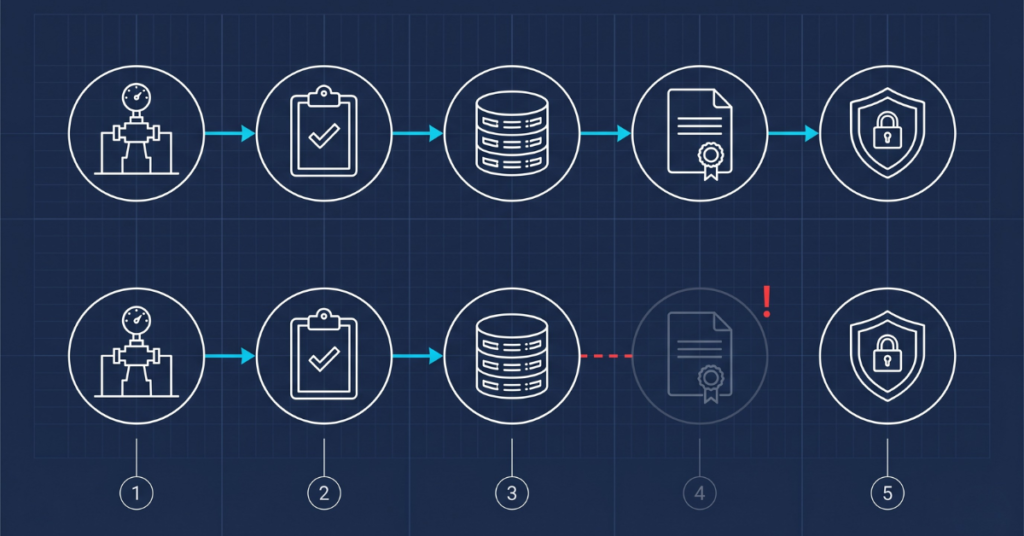
An operator whose field data pipeline runs through five systems has not improved compliance. “Tech records number on paper, someone re-enters it in Excel, someone else copies it into Petrinex, and we also ran it through an AI tool” adds a fifth system to a chain that already had too many. The operators who are actually building toward AI readiness in Canada are doing it by first getting their measurement and reporting data into a single, auditable system of record. The AI opportunity is downstream of that. Not a replacement for it.
How Do You Fix the Foundation First?
The industry is spending billions on AI while the field data feeding it is still being texted in photos and emailed in spreadsheets. That is why AI fails in oil and gas. Not because the models are wrong. Because the data is not ready.
Fixing this does not start with an AI vendor. It starts with a process audit. Where does data enter your system? How many times does it get re-entered? Where are the handoffs between field and office, between contractor and operator, between tracking system and regulatory submission? Each handoff is a place where data degrades. Remove the handoff, and the data stays clean from the point it was captured.
That is the work. It is not glamorous. It does not make the conference schedule. But it is the difference between operators who eventually deploy AI on a foundation that works and operators who keep cycling through pilots that never scale.
Your field data is the foundation. Start there. Book a Fieldshare demo and we will walk through exactly where your data chain breaks down and what removing those handoffs looks like in practice. Thirty minutes, your wells, your workflow.
Frequently Asked Questions
Why do most AI projects fail in oil and gas?
The failure rate is structural, not technological. RAND found that 80% of AI projects fail industry-wide, and oil and gas is worse than most sectors because of four compounding problems: field data captured on paper and re-entered manually, contractors submitting in incompatible formats, project managers tracking budgets in parallel personal spreadsheets, and regulatory submissions assembled from scattered files. Each of these is a handoff problem that AI cannot automate away. Fixing the handoffs is the prerequisite.
What percentage of oil and gas companies are actually using AI?
Only 3% of oil and gas companies report advanced or highly integrated AI use in daily operations, according to DNV’s 2024 Energy Industry Insights report. Another 47% are still in the planning or piloting stage. Most pilots never scale beyond the sandbox environment because the real operational data is too fragmented and inconsistent for the AI to process reliably.
Where does AI actually work in oil and gas?
AI delivers real value when it is trained on clean, structured data for a narrow, well-defined task. Decline curve analysis, predictive maintenance, and seismic interpretation are the clearest examples. Machine learning decline curve models achieve over 30% higher accuracy than traditional methods, and Devon Energy reported a 25% improvement in productive well life from AI-driven predictive maintenance. The common factor is that the input data was already structured and standardized before AI was applied.
What should oil and gas operators fix before deploying AI?
Operators should fix four things before considering AI: the field-to-office data handoff (eliminate paper and re-entry), contractor format inconsistency (standardize how data enters the system), parallel spreadsheet tracking (centralize project data into a shared platform), and regulatory submission assembly (connect source data to a single auditable record). Gartner found that organizations with successful AI initiatives invest up to four times more in data foundations than those with poor AI outcomes.
Does AI help with regulatory compliance in Canadian oil and gas?
AI-generated summaries, estimates, or interpretations do not satisfy Canadian regulatory requirements. The Alberta Energy Regulator’s Directive 017 requires measured values, documented methodology, and complete audit trails. The Enhanced Production Audit Program monitors Petrinex submissions monthly, and Directive 088 evaluates documentation completeness as an assessment criterion. Operators need a single, auditable system of record before AI can add value downstream.
How do you know if your field data is ready for AI?
If your data enters the system once, at the point of origin, in a consistent format, and stays accurate through its lifecycle without re-entry or manual reconciliation, your data foundation may be ready for targeted AI applications. If data is still being re-entered from paper, emailed as attachments, tracked in personal spreadsheets, or assembled manually for regulatory submissions, the foundation work needs to happen first.