How Oil and Gas Companies Use Workflow Software to Cut Double Data Entry
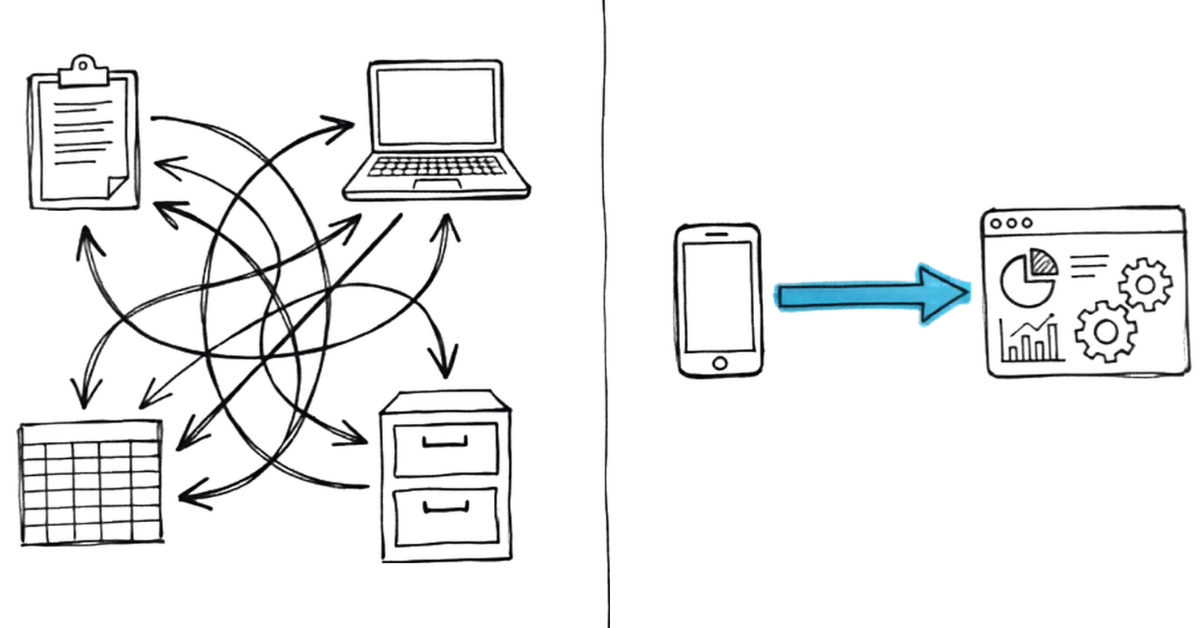
Most oil and gas operators have one number that gets entered three different times. A field tech records a reading at the wellhead. Someone at the office types it into a spreadsheet. A third person copies it into a regulatory submission. One number, three entry points, three chances to be wrong. Across a portfolio of 500 wells, that is thousands of redundant entries every week.
The 3 biggest causes of double data entry are well understood: too many tracking systems, too many stakeholders using different formats, and data that cannot move between the tools it sits in. What gets less attention is how much this costs a Canadian operator specifically, where AER and BCER documentation requirements turn every redundant entry into a potential compliance gap.
Oil and gas workflow management software exists to close that gap. Here is what the problem actually looks like, what the cost is in practice, and how three Canadian operators eliminated it.
The Real Cost of Re-Keying Data in Canadian Oil and Gas
In Canada, double data entry is not just an efficiency problem. It is a compliance problem.
The Alberta Energy Regulator’s Directive 088 requires operators to keep complete documentation across every asset they hold. The wording is explicit: licensees must “record and retain complete documentation and make such documentation available to the AER upon request.” The holistic licensee assessment that comes out of Directive 088 evaluates operators on six factors, two of which (operational capability and administrative compliance) depend entirely on the integrity of the underlying data.
Directive 011 sets the methodology for calculating deemed liability on Alberta’s roughly 470,000 licensed wells. Your liability position is only as accurate as the well data feeding it. If that data was re-keyed from a field notebook to a spreadsheet to a submission form, each stop introduces error risk and weakens the submission. Our guide lists the records that move your Directive 011 estimate, from well scenarios to abandonment reports.
Research by Ray Panko at the University of Hawaii found that 88% of spreadsheets contain errors, with mistakes showing up in roughly one out of every twenty cells. In a financial model, a cell error is embarrassing. In AER documentation, it can flag you for non-compliance, delay a licence transfer, or undermine your standing during a holistic assessment.
Alberta’s Environmental Protection and Enhancement Act adds another layer on top. Every application and every supporting document has formatting and submission rules. Operators who assemble these from scattered spreadsheets spend hours rebuilding what should be a continuous data trail.
The real question is not whether double entry is inefficient. Every operator already knows it is. The question is where exactly it happens, and what replacing it looks like.
Where Double Data Entry Happens in Oil and Gas Operations
Double entry does not happen in one place. It happens at every handoff in the data chain. For Canadian operators, four handoffs come up constantly.
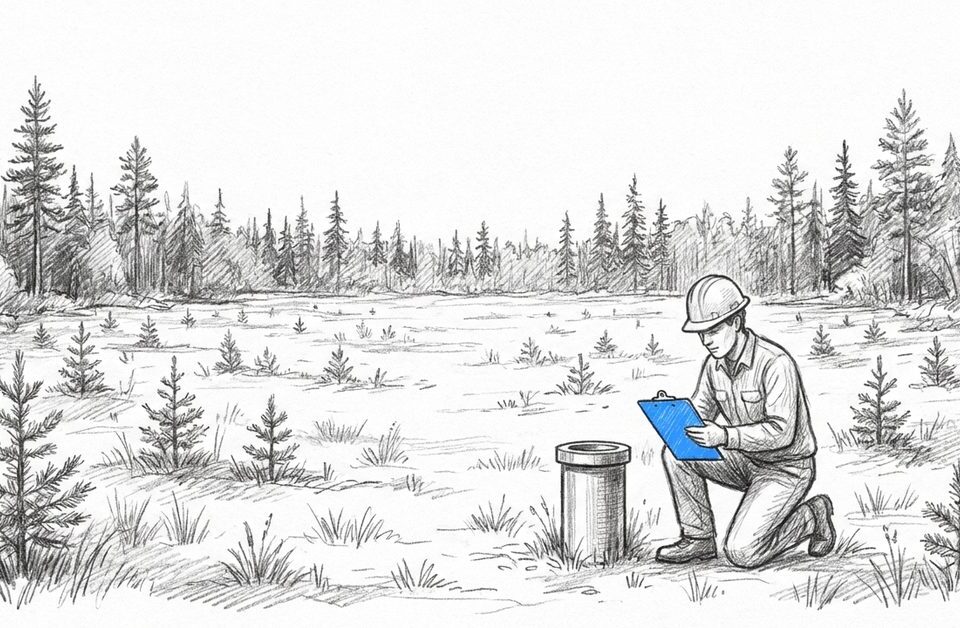
The field-to-office handoff is the first. Inspectors and field crews record data at well sites, pipeline right-of-ways, and facilities. Many of those locations have no cell service. Data starts on paper or a personal device, then gets re-entered into office systems when the crew gets back. Every re-entry is a transcription, and every transcription carries error risk.
The consultant-to-operator reporting handoff is the second. Operators commonly work with ten to twenty different environmental consultants, each submitting data in a format they chose. The City of Medicine Hat lived this: one environmental coordinator was consolidating data from 15 to 20 consultants across roughly 2,750 active sites. Different systems, different formats, one person holding it together. The coordinator spent more time organizing data than managing projects.
The third is cost tracking across project managers. When every PM keeps their own spreadsheet for budgets, tickets, and invoices, nothing reconciles. If one PM is out and a client calls for a budget update, nobody else can step in. Robin Weseen, VP of Operations at Summit Earth (an environmental consulting firm operating across Canada, the USA, and Australia) described a system where whole folders went missing and budget overruns surfaced only after the client relationship had already taken damage.
The fourth is regulatory submission assembly. When the AER asks for documentation, operators using spreadsheet-based systems describe spending days pulling records from scattered files and rebuilding them into a submission-ready format. The data exists somewhere. Assembling it from multiple sources is the expensive part.
What Happens When One Coordinator Manages 2,750 Sites on Spreadsheets
The City of Medicine Hat is the sixth largest city in Alberta and the only Canadian municipality that owns and operates its own natural gas production. Its Department of Natural Gas and Petroleum Resources manages roughly 2,750 active sites.
Before the city implemented workflow software, Tyler Britton (Environment Lead, Asset Liability and Closure) was trying to run that whole portfolio manually. Consultants emailed reports. Spreadsheets had version control problems. One manager would save a folder as “wellsite data” while another saved it as “well site data,” so finding a complete data set meant a treasure hunt every time. Important files were a careless click away from being lost.
The fix was structural, not incremental. Instead of consultants sending data in for someone at the city to re-enter, consultants now enter their data directly into Fieldshare. The re-entry step disappeared. Not reduced. Gone.
Tyler described the result: “Fieldshare saves us 20 hours per week in administration and data maintenance, updating records, organizing project data, and reporting.” That is over 1,000 hours a year. His capacity went from 250 sites to 750. The city avoided hiring two additional FTE positions it had no budget for, and after a full year on the platform it attributed a 300% increase in overall project volume to the system change.
One coordinator. 2,750 sites. The spreadsheet version of this job was not sustainable. The workflow software version is.
How Workflow Software Eliminates the Re-Entry Points
Each of the four handoffs above has a specific fix. Purpose-built oil and gas asset management software addresses them structurally, by removing the handoff instead of adding another system on top.
Field data is captured at the source. Offline data collection means field crews record inspection data, daily reports, and site observations on tablets or phones at the wellhead. Here is how offline capture removes the re-typing step once the crew is back in range. When connectivity returns, the data syncs automatically. No transcription from paper. No waiting for someone to drive back to the office and email their notes. Data enters the system once, at the point of origin.
Consultants enter directly into the system of record. Medicine Hat proved this works at scale. When 15 to 20 consultants enter their data directly into a shared platform instead of emailing reports in different formats, the consolidation step vanishes. The coordinator shifts from data entry to actual project management.
Standardized cost tracking replaces parallel spreadsheets. Summit Earth replaced their per-PM spreadsheet system with centralized cost tracking through Fieldshare. The result: a 50% reduction in how often projects went over budget. Robin Weseen described the shift this way: “Fieldshare has been a huge help in not overshooting a client’s budget. Projects go over budget, that happens. There’s too much uncertainty not to, but it’s about letting the client know in advance and not telling them afterwards that you were $10,000 too high.” The firm also saved five hours a week on invoicing and administration alone.
Compliance reports come out of the same data. Instead of assembling submissions from multiple spreadsheets, workflow software generates compliance reports from a single data source. Filter by site, date range, or inspection type and the report matches reality, because it pulls from the same place the data was originally captured. Jim Gordon, HSE Manager at Whitecap Resources Inc., put it plainly: “Fieldshare means quick data input and quick data retrieval. It gives me the tools I need to monitor everything and drive KPIs.” Whitecap cut data management time by 70% after centralizing their tracking.
The Compliance Dimension Canadian Operators Cannot Ignore
For operators outside Canada, workflow software is mostly an efficiency tool. For Alberta and BC operators, it is also a compliance tool.
Directive 088’s mandatory closure spending framework requires operators to plan and execute closure activities on a timeline. The industry-wide target for 2026 is $750 million. Budgeting closure work accurately means knowing your wells accurately. If the data feeding that budget was re-keyed through three systems before it got there, the budget is sitting on a foundation you cannot defend in a review.
The holistic licensee assessment evaluates operational capability alongside financial health. An operator whose documentation runs on manual re-entry from scattered spreadsheets looks different to a reviewer than one whose field data flows straight into a central system. The AER does not prescribe software. But the documentation standard it enforces (complete records, available on request) is effectively impossible to maintain at scale through manual processes. There is too much data, moving too fast, across too many hands.
Operators who also run Excel-based tracking systems for their AER liability obligations carry the compounding risk across both operational and financial systems. That exposure grows with every well added to the portfolio.
The Bottom Line
The pattern across Medicine Hat, Summit Earth, and Whitecap is consistent. Medicine Hat eliminated 20 hours of re-entry a week and tripled coordinator capacity. Summit Earth cut budget overruns by 50% and saved five hours a week on invoicing. Whitecap cut data management time by 70%. None of these came from working harder. They came from removing the handoffs where data gets re-entered.
For Canadian operators under Directive 088 and Directive 011, this is no longer just a productivity decision. Every re-keyed number is a documentation risk. Every parallel spreadsheet is a gap waiting to be found during an AER review.
The causes of double data entry are well documented. The fix is proven. The only open question is how long you continue paying for the same data to be entered twice.
Stop paying for the same data twice. Book a Fieldshare demo and we will show you exactly how Medicine Hat, Summit Earth, and Whitecap moved field data into their system of record in a single step. Thirty minutes, your wells, your workflow.