Conservation Authorities Ontario: A Practical Guide for Environmental Consultants
Conservation authorities in Ontario number 36 on November 24, 2026. Any of them can require a permit before your crew works in a floodplain, wetland or shoreline area. On February 1, 2027 they are scheduled to become nine.
This guide covers the conservation authorities that Ontario consultants meet most often, for field work that crosses several watersheds. The permit rules themselves have not changed in 2026; what changes is who you file with. Each fact was checked on November 24, 2026 against e-Laws (current to November 19), the Environmental Registry and the authorities’ own documents.
At a Glance
- There are 36 authorities today and nine from February 1, 2027. The merger is law, but a regulation can set a later date.
- The merger leaves the permit rules unchanged. Section 28 of the Act and O. Reg. 41/24 still apply. Amendments are only proposed.
- Regulated areas need a permit. These are hazardous lands, wetlands plus 30 metres, river or stream valleys and shorelines.
- Two clocks are set in law. The authority has 21 days to confirm an application is complete. After 90 days without a decision, you can appeal to the Ontario Land Tribunal.
- Records must follow the authority. Conditions, expiry dates and monitoring evidence need one home per site.
What Is a Conservation Authority, and What Do They Regulate?
A conservation authority is a local public body, set up under the Conservation Authorities Act, that manages natural hazards and water resources for a watershed. For consultants, the part that matters is permitting. Authorities regulate development and interference with watercourses and wetlands in hazardous areas such as floodplains, shorelines and wetlands.
The Province describes authorities as “local public sector organizations”. Beyond permits, they run flood forecasting, monitor water, manage their own land and comment on planning applications for natural hazard risk.
Authorities are not the environmental assessment body. Under O. Reg. 686/21, they review environmental assessment proposals only to comment on natural hazard risks. And since April 1, 2024, the permit tests no longer cover pollution or the conservation of land, as Hamilton Conservation Authority explains.
How Many Conservation Authorities Does Ontario Have Today?
Ontario has 36 conservation authorities on November 24, 2026. Under Part I.1 of the Act, 35 of them merge into eight regional authorities on the transition date. The Lakehead authority continues under a new name, giving nine. The transition date is February 1, 2027, or a later date if a regulation sets one.
The merger law is in force. Bill 97 received Royal Assent on April 24, 2026. The Ontario Provincial Conservation Agency, created on November 27, 2025, leads the transition. Its project executives, appointed in July 2026, lead eight transition committees.
What changed | When | Status |
|---|---|---|
O. Reg. 41/24 replaces 36 authority regulations | April 1, 2024 | In force |
Ontario Provincial Conservation Agency created | November 27, 2025 | In force |
Merger law (Part I.1 of the Act) | April 24, 2026 | In force |
36 authorities become 9 | February 1, 2027 | Scheduled |
Changes to O. Reg. 41/24 for the new regions | Comments close December 6, 2026 | Proposed |
Bill 143, Schedule 11, more changes to the Act | Passed second reading November 5, 2026 | Not law |
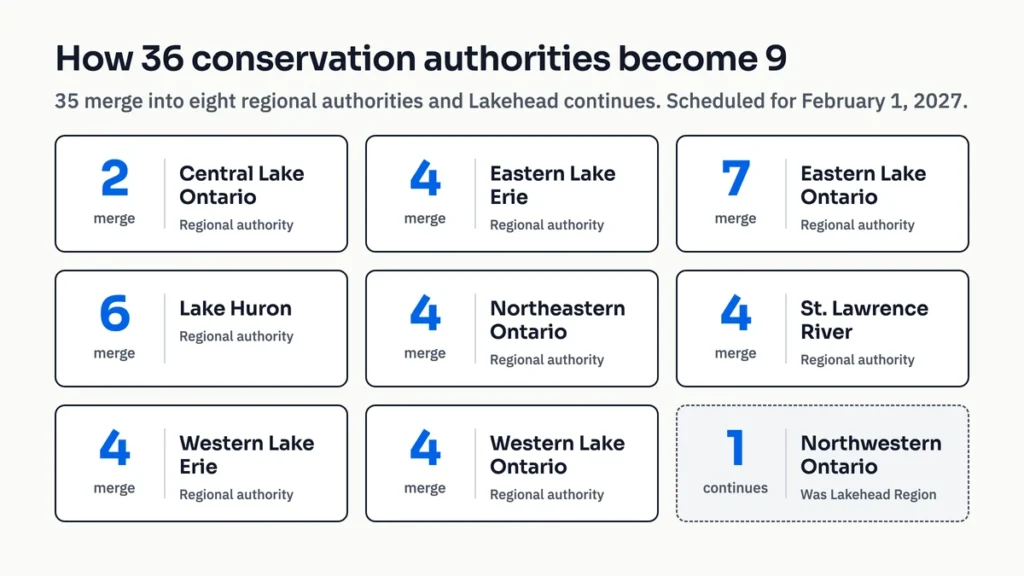
Until the transition date, the existing authorities carry on. The Minister’s direction in force since May 1, 2026 lists decisions that need the agency’s approval, such as land purchases and senior hires. Permit decisions are not on that list.
How Do You Find Which Conservation Authority Covers a Site?
Start with Conservation Ontario’s locator, then confirm on the authority’s own regulated-area map. Every authority must publish those maps and review them at least once a year. If a map and the regulation disagree on a boundary, the regulation’s written description prevails (O. Reg. 41/24, section 4(5)).
A search for Ontario’s conservation authorities leads to a locator of 36 listings. Conservation Ontario says its map “is for information purposes only”. Treat it as a pointer, not an answer.
Crossing watersheds is normal. The Province says more than half of municipalities fall under two or more authorities. Section 28 applies “in the area of jurisdiction of an authority”. A pipeline survey or road corridor that crosses two jurisdictions is two permit questions, each with its own authority.
After February 1, 2027, the same address will sit with one of nine regional authorities. The Province publishes a map of the new boundaries, marked as illustration only.
When Does Field Work Need a Section 28 Permit?
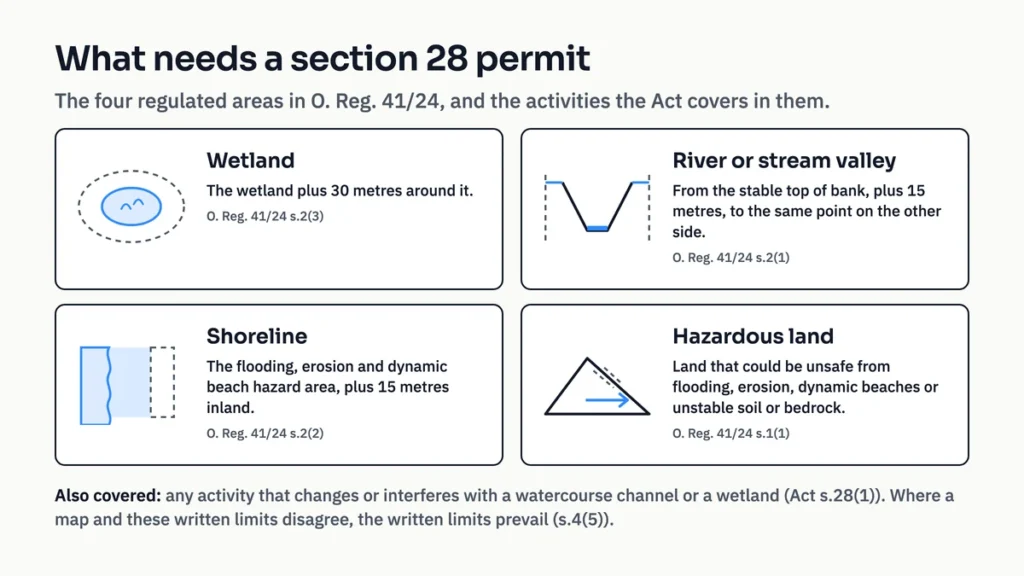
You need a permit when work interferes with a watercourse or wetland, or is a development activity in a regulated area. Regulated areas are hazardous lands, wetlands, river or stream valleys and shoreline areas, plus 30 metres around a wetland. Section 28 binds anyone who carries out the activity or permits another person to.
“Development activity” covers building or changing a structure, site grading, and “the temporary or permanent placing, dumping or removal of any material”. The Act leaves the limits to O. Reg. 41/24:
- Wetlands: the wetland plus 30 metres around it. A wetland must meet all four tests: shallow water or a high water table, a hydrological link to a watercourse, hydric soils and hydrophytic vegetation.
- River or stream valleys: from the stable top of bank, plus 15 metres, to the same point on the other side.
- Shorelines: the flooding, erosion and dynamic beach hazard area, plus 15 metres inland.
Small investigations are the grey zone, because the definition covers grading and removing material. The Nottawasaga Valley Conservation Authority’s procedures list “Boreholes and test pits for geotechnical investigations that do not require the construction of an access road” as exceptions. Do not assume another authority does the same. Ask in pre-submission consultation.
Guessing wrong is costly. A corporation can be fined up to $1,000,000, plus up to $200,000 for each day the offence continues (section 30.5).
What Goes Into a Permit Application?
An application needs a plan of the work, its purpose, dates, methods, grades, drainage details, a description of any fill and the owner’s authorization. The authority may also request studies. Each authority sets its own fees. You can ask for a pre-submission consultation first, and the authority must take part.
Section 7 of the regulation lists the contents. The owner’s authorization matters to consultants. If you apply for a client who does not own the land, the application needs written confirmation from the owner.
A pre-submission consultation (section 6) can include site visits. Once the application is complete, the authority “shall not require new studies, technical information or plans” unless you agree. It may still ask for clarification.
Fees come from each authority’s fee schedule. A Minister’s direction bars permit fee changes from March 10, 2026 to February 28, 2027, so today’s schedule holds through the merger date.
How Do Permit Timelines Work?
The authority has 21 days after it receives your information and fee to say in writing whether the application is complete. Decision targets after that come from each authority’s policy. With no decision after 90 days, you can appeal to the Ontario Land Tribunal. A permit lasts at most 60 months, including extensions.
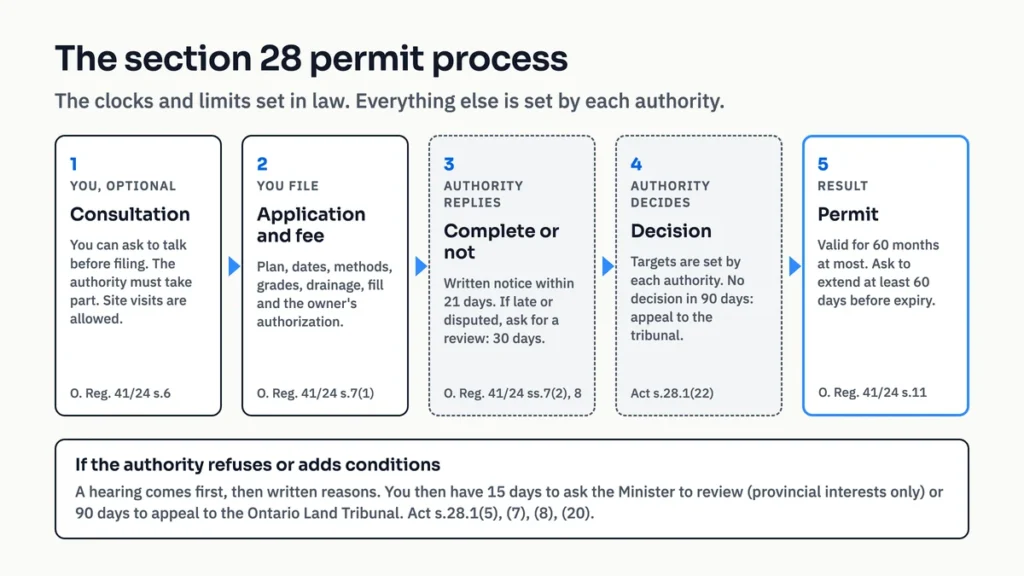
If you disagree with the completeness decision, you can request a review. The authority must finish it within 30 days (section 8). The Province’s guide repeats both clocks in plain language.
Decision targets differ. Crowe Valley Conservation Authority’s policy cites provincial guidance of 30 days for a minor application and 90 days for a major one. Every authority must also publish an annual permit report under O. Reg. 686/21. Read it before you promise a client a date.
To extend a permit, apply at least 60 days before it expires.
What Happens If an Authority Refuses a Permit or Adds Conditions?
An authority cannot refuse a permit or attach conditions until you have had a chance to be heard, and it must then give written reasons. You can appeal to the Ontario Land Tribunal within 90 days of the reasons. Or you can ask the Minister to review within 15 days, which applies only to matters of provincial interest.
Conditions are limited. Under section 9 of the regulation, each one must do one of three things. It helps prevent or mitigate effects on flooding, erosion or unstable soil. It protects health and safety. Or it will “support the administration or implementation of the permit”, including reporting, notification and monitoring. That last group makes a permit a record-keeping job, much like tracking restoration work over several seasons.
The two routes do not overlap. If you ask the Minister to review, the Ontario Land Tribunal route opens in only three cases. The Minister refuses, 30 days pass with no reply, or an agreed review runs past 90 days. O. Reg. 474/24 limits reviews to provincial interests such as housing, infrastructure and jobs.
An authority can also cancel a permit if its conditions are not met. It must first give notice, and you have 15 days to request a hearing.
Do the Rules Differ Between Authorities Now?
Less than before April 1, 2024, but yes. One regulation now replaces 36 separate authority regulations, so definitions, the 21-day completeness check and the 60-month limit match everywhere. Flood standards, shoreline allowances, fees, decision targets, forms and local policies still vary by authority.
The Province’s notice says O. Reg. 41/24 “applies to all CAs but maintains local differences”.
Topic | Same everywhere | Varies by authority |
|---|---|---|
Regulated areas | Definitions, 30 metre wetland allowance | Flood event standard, shoreline and valley allowances |
Application | Contents list, 21-day completeness check | Forms, portals, studies requested |
Decision | Hearing before refusal, 90-day tribunal appeal | Target decision times |
Fees | Fee reconsideration within 30 days | The amount of each fee |
Conditions | The test in section 9 | Lake Simcoe adds its Protection Plan policies |
Schedule 1 of the regulation sets the flood event standard in 20 tables. Credit Valley applies the Hurricane Hazel and 100 Year standards, Rideau Valley the 100 Year standard alone, and Upper Thames the 1937 event. The dynamic beach allowance is 30 metres inland, but 15 metres in Mattagami, Nickel District and North Bay-Mattawa.
What Does the 2027 Consolidation Change for Active Files?
Permits and pending applications carry over. On the transition date a new authority takes its predecessors’ place, and a pending application continues with it. The merger is deemed not to breach any permit. The Province also proposes amending O. Reg. 41/24 so existing technical standards keep applying in the right watersheds.
After February 1, 2027, Ontario’s conservation authorities will number nine. Each new authority’s area is the sum of its predecessors’ areas. The proposed amendments, open for comment on the Environmental Registry until December 6, 2026, would also correct some flood standards and shoreline allowances. The Province says they are “not expected to change the CA permitting process”. None is in force.
Bill 143, Schedule 11, would change the Act again. It passed second reading on November 5, 2026 and is not law.
For each open file, note the predecessor and its new authority. After February 1, 2027, re-check the contact, portal and fee schedule. Whether each predecessor’s local policies carry over is not stated in the sources we read, so ask.
How Should Consulting Firms Keep Records Across Authorities?
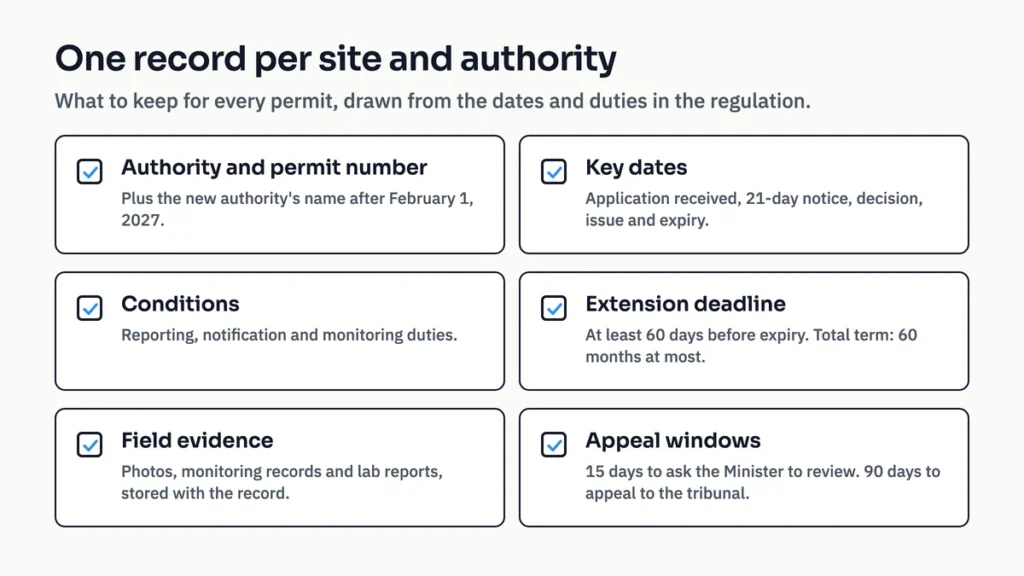
Keep one record per site, tagged with its authority, so each permit’s number, conditions, dates and field evidence can be found without searching email. Conditions on reporting, notification and monitoring make a permit a record-keeping duty, and the 60-month cap puts expiry and extension dates on the calendar.
For each site and authority, record:
- The authority and its permit number, plus the new authority’s name after February 1, 2027.
- The dates: application received, completeness notice (the 21-day clock), decision, issue and expiry.
- The conditions, with their reporting, notification and monitoring duties.
- The extension deadline, at least 60 days before expiry.
- Site photos, monitoring records and lab reports, stored with the record.
- Hearing notices and written reasons, with the 15-day and 90-day appeal windows noted.
Fieldshare is built for this kind of record-keeping at environmental consulting firms. It links files, photos, forms and tasks to each site record. Crews can use field data capture that works offline at remote sites. Tasks send notifications on deadlines, so a permit’s expiry date sits beside the monitoring data its conditions require. Lab reports are stored with the records. For the wider picture, see our guide to environmental data management software.
Working across several watersheds? See how Fieldshare works for environmental consultants, read the Arletta Environmental case study, or book a demo.
Frequently Asked Questions
How long does a conservation authority permit take?
The authority has 21 days to confirm an application is complete. Decision targets are set by each authority, and some cite 30 days for minor and 90 days for major applications. With no decision after 90 days, you can appeal to the Ontario Land Tribunal.
How long is a conservation authority permit valid?
At most 60 months, extensions included. If it was issued for less, apply for an extension at least 60 days before it expires. If the authority intends to refuse an extension, it must give notice, and you have 15 days to ask for a hearing.
What happens to my application when the authorities merge?
It continues with the new authority. The Act says an application made before the transition date and not yet decided becomes an application to the predecessor’s new authority. Hearings and appeals already underway continue the same way, with the new authority as the party.
Can I appeal a conservation authority's permit decision?
Yes. After a refusal or conditions, you can appeal to the Ontario Land Tribunal within 90 days of the written reasons. Or ask the Minister to review within 15 days. That route applies only to matters of provincial interest, and the Minister’s decision is final.